

Contents
- 1. Why the background carries half the realism
- 2. The bedroom: the easiest room
- 3. The living room: the hardest common room
- 4. Light is the setting
- 5. Clutter kills realism
- 6. Fixing a bad background
- 7. What it costs
- 8. Honest limitations
- 9. Toestemming: only yourself or fictional adults
- 10. FAQ
1. Why the background carries half the realism
Look at a generated image for one second and ask yourself what you actually saw. It was not the body — it was the whole scene, and the scene is mostly room. The wall, the window, the bed, the light on the floor: these fill two-thirds of the frame, and they are the first thing your brain checks for consistency. A body can be perfect and still fail if the room is wrong, because the room is the evidence that the body is really there. That is why the room is half the result, and why the cheapest way to improve an undress is often to simplify the room instead of re-rolling the body.
There are three ways a background betrays a generated image. Eerst, light that does not match: the body is lit from the left while the window is on the right, or the shadow on the floor points a different way than the shadow on the wall. Tweede, objects that are almost right: a picture frame that hangs crooked, a chair leg that disappears, a plant that floats a centimeter above the floor. Third, clutter — so many objects that each one is a new chance for the model to make a mistake. A simple room removes all three risks at once.
| Room | What works | What fails | Best light |
|---|---|---|---|
| Bedroom | Plain wall, one window, bed as anchor | Mirrors, cluttered nightstand | Morning window light |
| Living room | Sofa, one plant, one lamp | TV, mixed lamps, too much furniture | Evening window light |
| Bathroom | Tiles, one mirror, clean lines | Mirror reflections, steam, glass | Bright overhead light |
| Studio | Plain backdrop, single softbox look | Feels staged, no context | Soft even light |
| Outdoors | Garden, beach, natural light | Complex trees, crowds, sky errors | Golden hour |
2. The bedroom: the easiest room
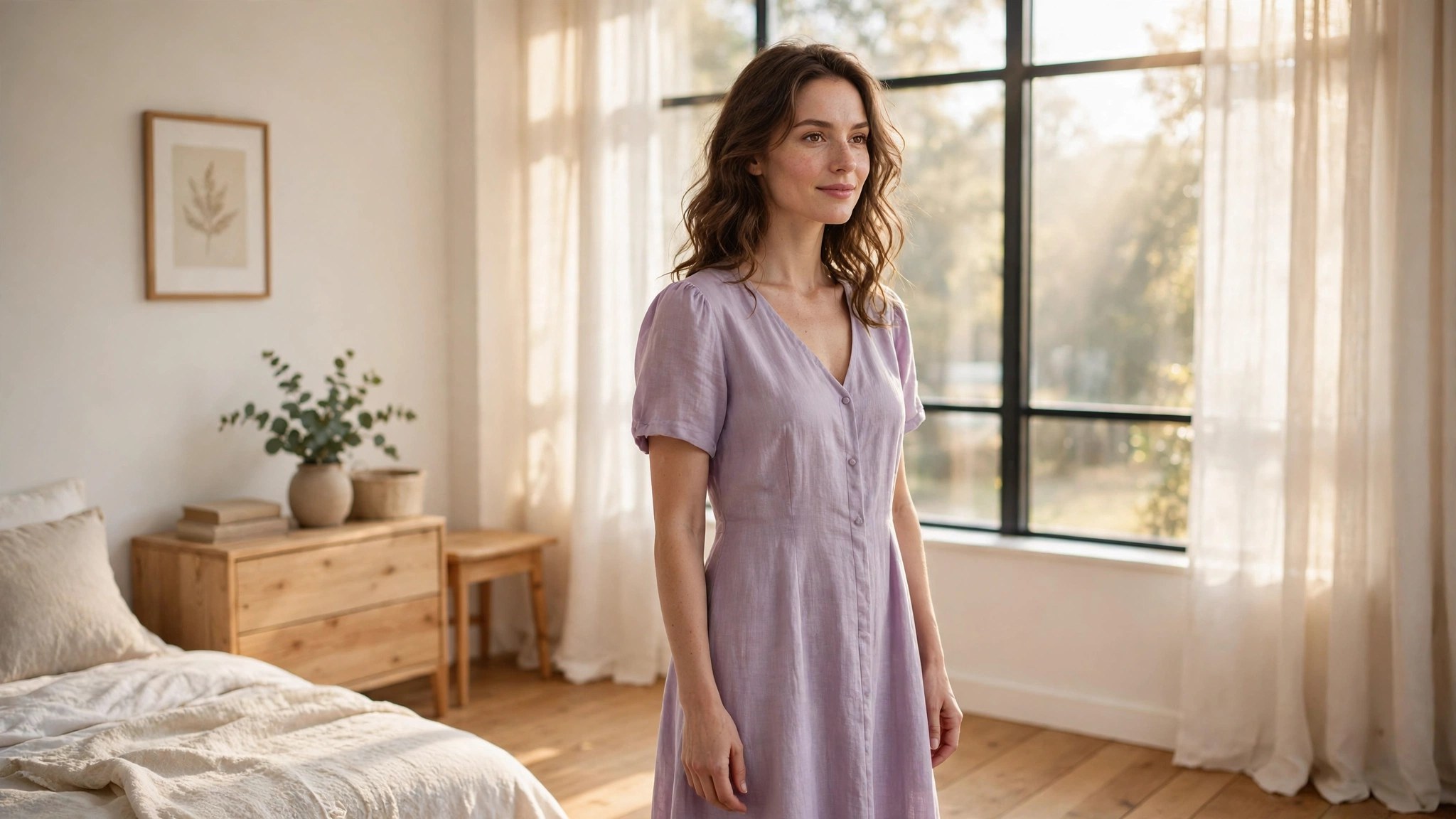
The bedroom is the easiest room for a generator to draw, and the most natural one for an undress result. It has a simple layout — bed, wall, window — and the model has seen millions of bedrooms, so it knows what one looks like. A plain wall behind the subject does most of the work: it gives the image a clean background, a single light direction, and nothing to get wrong.
Two details make a bedroom work. Eerst, the window should be the only strong light source. One window, one direction, one set of shadows. If the image also has a lamp, a ceiling light, and a bright doorway, the light stops making sense and the eye notices. Tweede, keep the bed simple: a plain duvet, one or two pillows, no patterned bedding. Patterns are where generators fail — a striped duvet becomes wavy lines, a floral pattern becomes a smear. Plain bedding is invisible, which is exactly what you want from a background.
What to avoid in a bedroom: mirrors, and anything on the nightstand. A mirror doubles the work — the model must draw the room twice, once reflected, and the reflection almost never matches. A cluttered nightstand is the same problem in miniature: every bottle, book, and cable is a new object to get wrong. Keep the nightstand empty or out of frame.
3. The living room: the hardest common room
The living room is where most background failures happen, because it is the room with the most stuff in it. A sofa, a coffee table, a TV, a lamp, a plant, a rug, a bookshelf, a window — each one is an object the generator must draw correctly, and each one is a chance to fail. The most common failures are the TV (a black rectangle that reflects a room that does not exist), the bookshelf (books that melt into colored bars), and the rug (a pattern that warps where the floor should be flat).
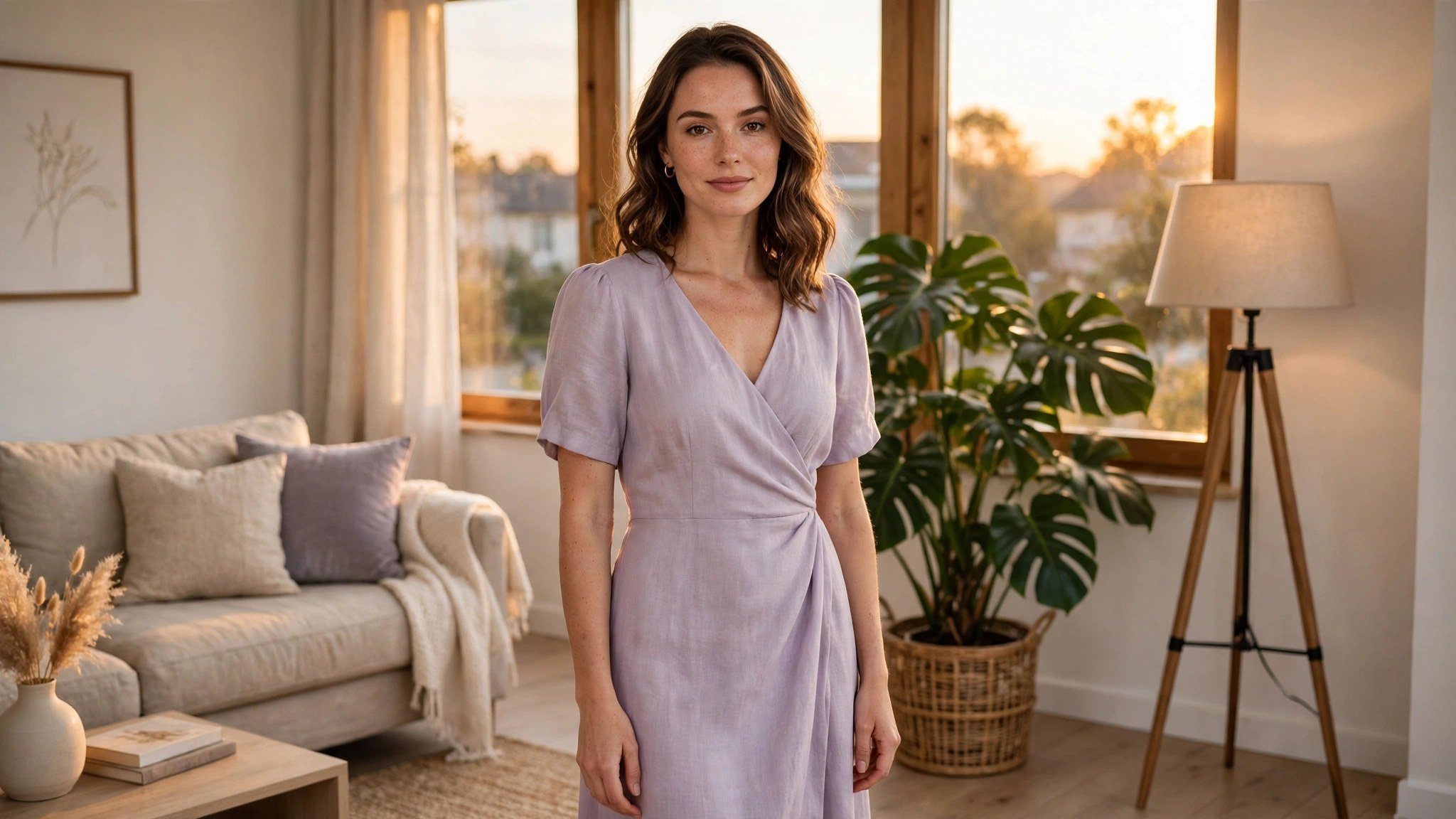
If you want a living room, simplify it the way a photographer would: sofa, one plant, one lamp, plain wall. That is the whole set. The plant should be large and simple — a monstera or a fiddle leaf, one pot, no small leaves to merge. The lamp should be off or dim, so it does not compete with the window as a light source. And the TV should not be in the frame at all — move the camera, of snijd het eruit.
4. Light is the setting
The room is the setting, but light is what makes the setting believable. A generated image fails when the light on the body and the light on the room disagree: the face is lit from the left while the window is on the right, or the body’s shadow falls toward the camera while the furniture’s shadows fall away from it. The eye catches this instantly, even when it cannot say why.
The fix is to pick one light source and name it in the prompt: “warm morning light from a large window on the left, soft shadows falling to the right.” Morning light is the safest choice — it is soft, directional, and warm, and it flatters skin. Evening light is the next best: golden, low, and dramatic, but it can turn the room orange if the prompt is not careful. Overhead light is the worst for realism — it flattens the face and makes the room look like an office.
Check the light in three places after every generation: the shadow on the floor (does it point away from the window?), the light on the face (does it come from the same side as the window?), and the brightness of the background (is the wall near the window brighter than the wall opposite?). If all three agree, the room will read as real. If one disagrees, regenerate — the room is half the result, and a wrong light is a wrong room.
5. Clutter kills realism
Every object in the background is a small test the generator must pass, and clutter is many tests at once. A room with ten objects has ten chances to fail; a room with three objects has three. The rule is simple: three objects at most, and each one large and simple. A bed, a plant, a lamp. A sofa, a rug, a window. That is enough to make a room feel lived-in without giving the model anything complicated to draw.
The objects to avoid are the small, detailed ones: books, bottles, cables, jewelry, remote controls, picture frames with images inside them. Each one is a detail the model must invent, and invented details are where the errors live. A picture frame is the worst offender — the model must draw a frame, a picture inside the frame, and the perspective of both, and the picture inside is almost always a smear. Use a blank frame, or no frame at all.
There is a second reason to keep the room simple: clutter competes with the subject. The eye goes to the busiest part of the image, and if the busiest part is a bookshelf, the body stops being the subject. A plain background keeps the attention where it belongs — on the person.
6. Fixing a bad background
When a generation comes back with a good body and a bad room, do not throw the whole image away. An image-to-image pass can fix the background alone: prompt for the room, not the body — “simple bedroom, plain wall, one large window with warm morning light, empty nightstand, no mirror, no clutter.” A targeted repair costs 49 credits ($0.98 op de $19.99 pakket, $0.59 op de $59.99 pakket) and works best when the body is already right.
If the repair does not work, crop tighter. A closer crop removes the background from the frame, and the problem disappears with it. A waist-up or chest-up crop needs almost no room at all — just a plain wall and a window edge. And if even that fails, regenerate with the simplest room you can describe: “plain wall, one window, warm morning light.” The simplest room is the one the model gets right most often.
7. What it costs
The site offers free access, so you can try the core features without a subscription before spending anything. A single undress costs 21 credits: $0.42 op de $19.99 pakket, $0.25 op de $59.99 pakket. Three attempts — the usual number to get the room right — cost 63 credits: $1.26 of $0.76. A targeted image-to-image repair of the background costs 49 credits: $0.98 of $0.59. A full set of three attempts plus one repair is 63 + 49 = 112 credits: $2.24 op de $19.99 pakket, $1.34 op de $59.99 pakket.
The expensive mistake is re-rolling the same busy room and hoping it works. It will not — the room is the problem, niet het lichaam. Spend one attempt on the busy room, one on the simple room, and keep the simple one. That is how the room is half the result, and how the test saves you credits instead of costing you more.
8. Honest limitations
This guide is based on reviewing generated images, not on a controlled benchmark — there are no published accuracy numbers for background generation, and none are claimed here. Different models fail differently: one may draw bedrooms well and living rooms badly, another the reverse. The room ranking reflects what this site’s generator produces in practice, not a universal law.
Backgrounds are also the area where the model is improving fastest. A living room that fails today may work in six months, and the ranking above will need updating. The three checks — light direction, object count, and clutter — will stay useful even as the models change, because they are checks of what a real room looks like, not of what one model does.
9. Toestemming: only yourself or fictional adults
The room does not change the consent rule: only generate intimate or explicit imagery of yourself, or of fully fictional adult characters you created. Never use a real person’s face, body, or likeness without their explicit consent — not a celebrity, not a classmate, not a colleague, not a stranger whose photo you found online. A beautiful room does not make an unconsented image acceptable, and a simple room does not make a consented image less valuable. Keep the subject fictional or yourself, and the background stays a craft question instead of an ethics problem.
10. FAQ
Why does the background matter so much in an undress?
The background fills most of the frame and carries all of the light. A fake-looking room makes a believable body look fake, because the room is the evidence that the body is really there.
What is the best room for an AI undress?
A simple bedroom: plain wall, one large window, a bed as an anchor. One light source, three objects at most, no mirror, no clutter.
Should I include a mirror in the background?
Nee. A mirror forces the model to draw the room twice, and the reflection almost never matches. Keep mirrors out of frame.
Can I fix a bad background without regenerating?
Sometimes. A targeted image-to-image pass costs 49 credits ($0.98 op de $19.99 pakket, $0.59 op de $59.99 pakket) and works best when only the room is wrong. Cropping tighter also works — a closer crop removes the room from the frame.
How many objects should be in the background?
Three at most, each large and simple: a bed, a plant, a lamp. Small detailed objects — books, bottles, cables, picture frames — are where generators fail.
Does the time of day matter?
Ja. Morning window light is the safest — soft, directional, and warm. Evening light is dramatic but can turn the room orange. Overhead light flattens the face and makes the room look like an office.
Lees verder
- AI-uitkleedresultaten per lichaamstype: Wat verandert, What Stays the Same (2026)
- Uitkleden voor video: Stills vs Clips — What Actually Works (2026)
- Wat te dragen voor AI-uitkleden: Hoe elk kledingstuk het resultaat verandert (2026)